India supplies a large share of the world’s spices, and almost every spice is sold against measurable grades rather than a single price. Knowing the numbers lets you buy the right quality instead of overpaying, or under-buying.
Turmeric: it’s about curcumin and colour
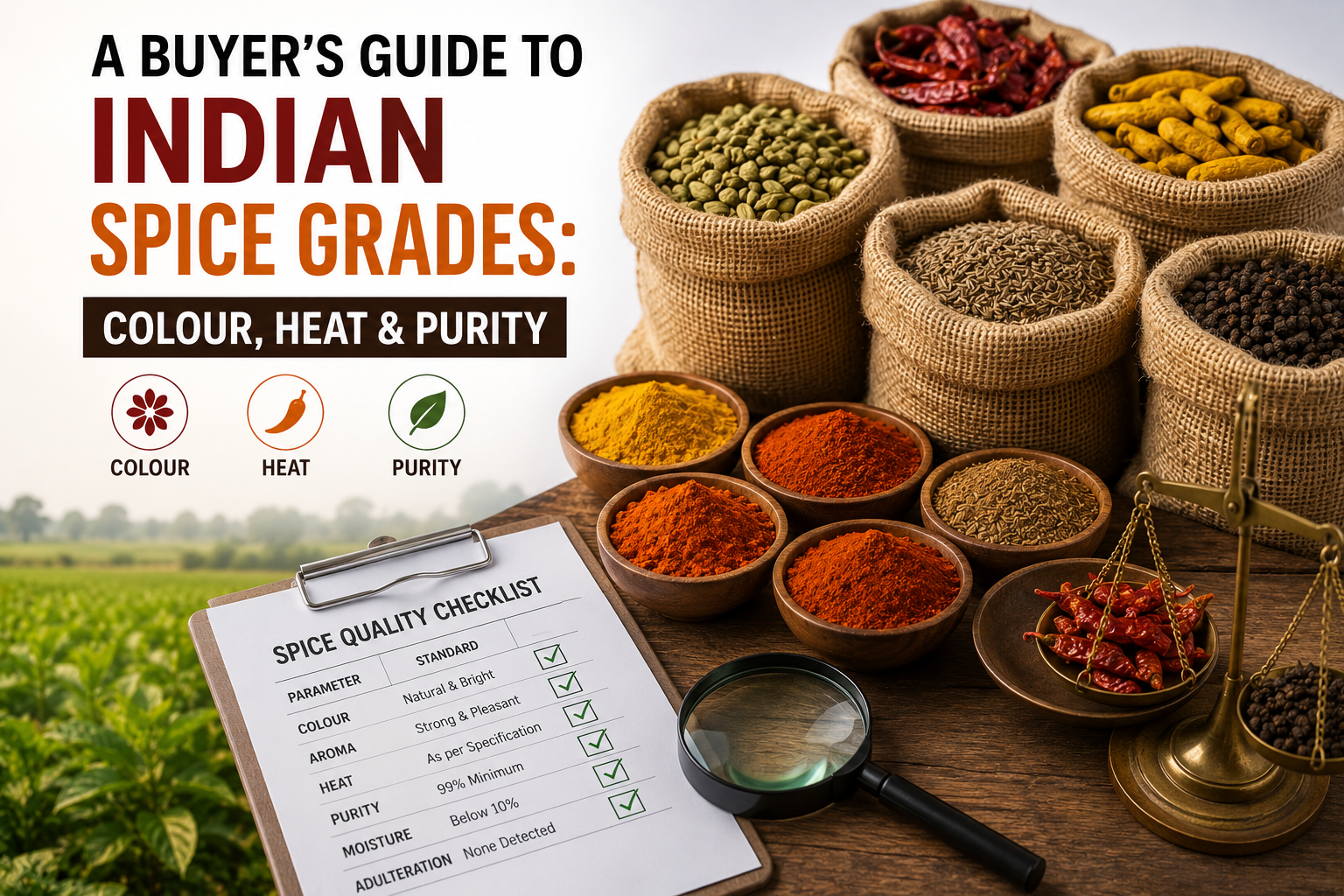
Turmeric is graded on curcumin content (typically in the 2-5% range) and brightness of colour. Polished fingers and machine-milled powder are both available; lower moisture and sortex cleaning protect colour in storage.
Red chilli: choose colour or heat
Chilli varieties trade on two axes: ASTA colour value and SHU (Scoville) heat. High-colour Byadgi is prized for extract and appearance; high-heat Teja delivers pungency; Sannam sits in between. Decide whether your product needs colour, heat or both, then specify the variety.
For chilli, “hotter” and “redder” are different orders. ASTA buys colour, SHU buys heat.
Cumin and coriander: purity and aroma
Cumin (jeera) is graded by machine-cleaned purity, 99% or 99.5%, with aroma and oil content driving quality. Coriander trades by variety (Eagle, Single-parrot) and form: whole, split or ground.
Black pepper: pungency and density
Pepper is sold garbled (GL) or ungarbled, by bulk density (commonly 500-600 g/l), with piperine driving pungency. Whole, cracked and ground forms are available.
Whole, ground and packed to you
Most spices ship whole or ground, in consumer packs or 25-50 kg bulk, with private-label options. We sample to your colour, heat, purity and moisture spec before shipment.
Frequently asked questions
How are Indian chillies graded?
What purity grades are cumin seeds available in?
Do you offer private-label spice packing?
Sourcing Spices?
Talk to our team for current grades, packing and availability.