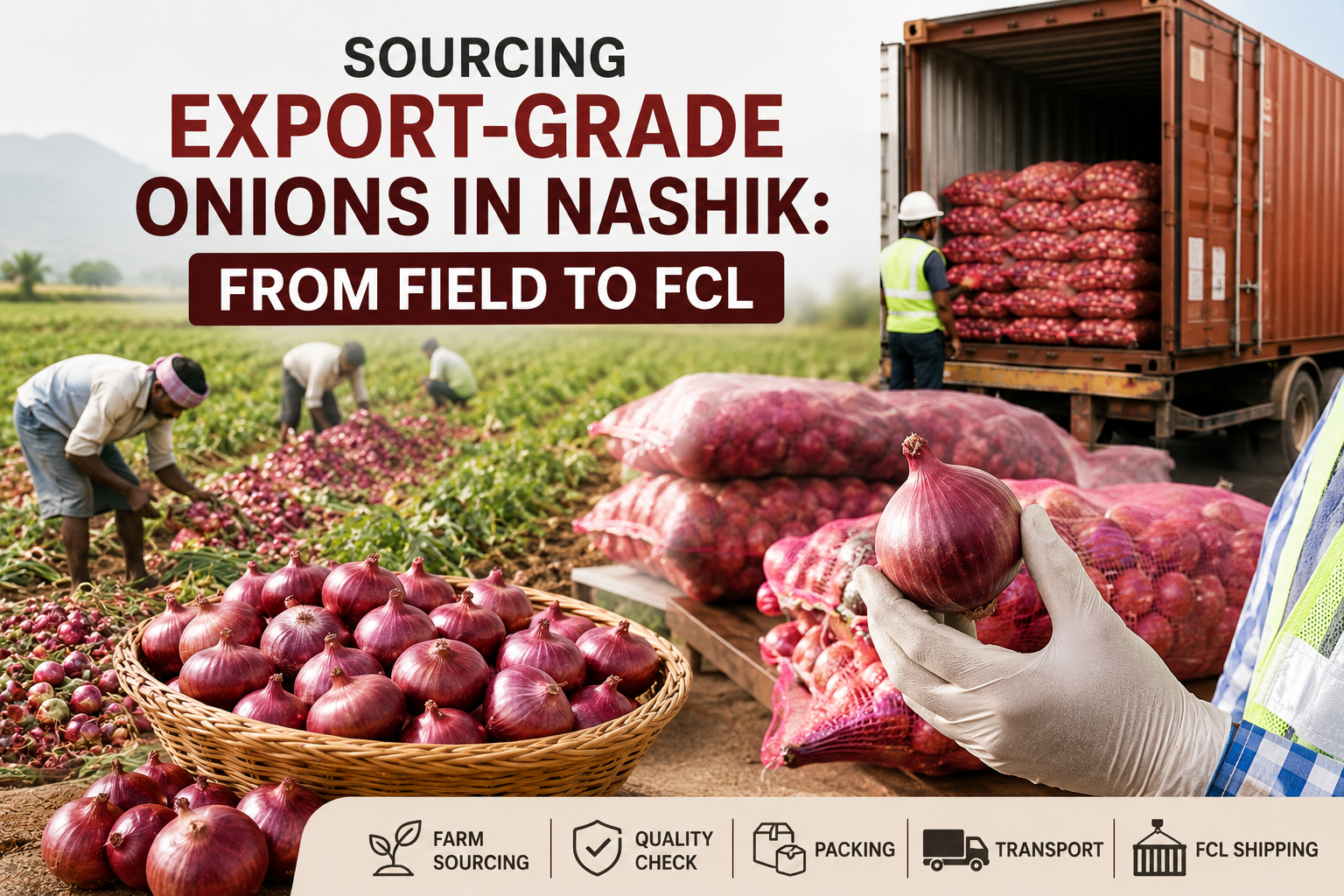
Nashik and the surrounding districts of Maharashtra account for a large share of India’s onion crop, and the region’s growing calendar lets exporters offer bulbs for most of the year. But geography alone does not make an onion export-ready. What separates a container that arrives firm from one that arrives sprouting comes down to three unglamorous steps: curing, grading and ventilation.
Curing is what buys you shelf life
After lifting, onions need to be cured so the outer scales dry into a papery, protective skin and the neck seals. Properly cured bulbs lose far less moisture in transit and resist neck rot. We work with single-harvest lots so a container has uniform maturity, rather than mixing early and late bulbs that age at different rates.
Grading is a promise to your customer
Size grades, typically 40-60 mm, 55-70 mm and 60 mm and above, are not just cosmetic. Your retail or processing customer is buying a count and a calibre, and consistency protects your reputation as much as ours. We grade mechanically and hand-check, then match the grade to the destination: Gulf retail, Southeast Asian wholesale or processing lines each have their own preference.
The cheapest onion at the farm gate is rarely the cheapest onion on arrival. Transit loss is the number that matters.
Packing for airflow, not just weight
Onions breathe. Ventilated mesh or jute bags in 5, 10, 20 or 25 kg let heat and moisture escape; a poorly chosen liner can trap condensation and undo good curing. For longer routes we advise palletised, ventilated stowage so air moves through the stack.
Documentation and traceability
Every shipment carries the paperwork importers expect, phytosanitary certificate, certificate of origin and commercial documents, and we can trace a lot back to its sourcing window. That traceability is increasingly a condition of entry, not a nice-to-have.
If you are evaluating an Indian onion supplier, ask three questions: how are the bulbs cured, how are they graded, and how are they packed for the specific route. The answers tell you almost everything about how the container will land.
Frequently asked questions
What sizes of onion are available for export?
What is the minimum order quantity for onions?
Which ports do you ship onions from?
Sourcing Onions?
Talk to our team for current grades, packing and availability.